A fully loaded 747 weighs nearly a million pounds. How does something that heavy stay aloft? The answer involves more physics than you might expect—and some common explanations are incomplete.
The Incomplete Explanation
You've probably heard that curved wings make air travel faster over the top, creating lower pressure that lifts the plane. This is partially true but insufficient—it doesn't explain how planes fly upside down or why flat-bottomed wings work.
Newton's Third Law
A more complete explanation involves reaction forces. Wings are angled to push air downward. Newton's third law states that every action has an equal and opposite reaction. Pushing air down creates an upward force on the wing—lift.
The Full Picture
Both explanations contribute. The wing's angle (angle of attack) deflects air downward, creating reaction lift. The wing's curve (airfoil shape) creates pressure differences that also generate lift. Most of the lift comes from angle of attack, which is why planes can fly inverted briefly.
Why Speed Matters
Lift increases with speed. At takeoff speed, wings generate enough lift to overcome the aircraft's weight. Too slow, and the plane stalls. Too fast, and structural limits become a concern. Pilots manage this balance throughout flight.
The Four Forces
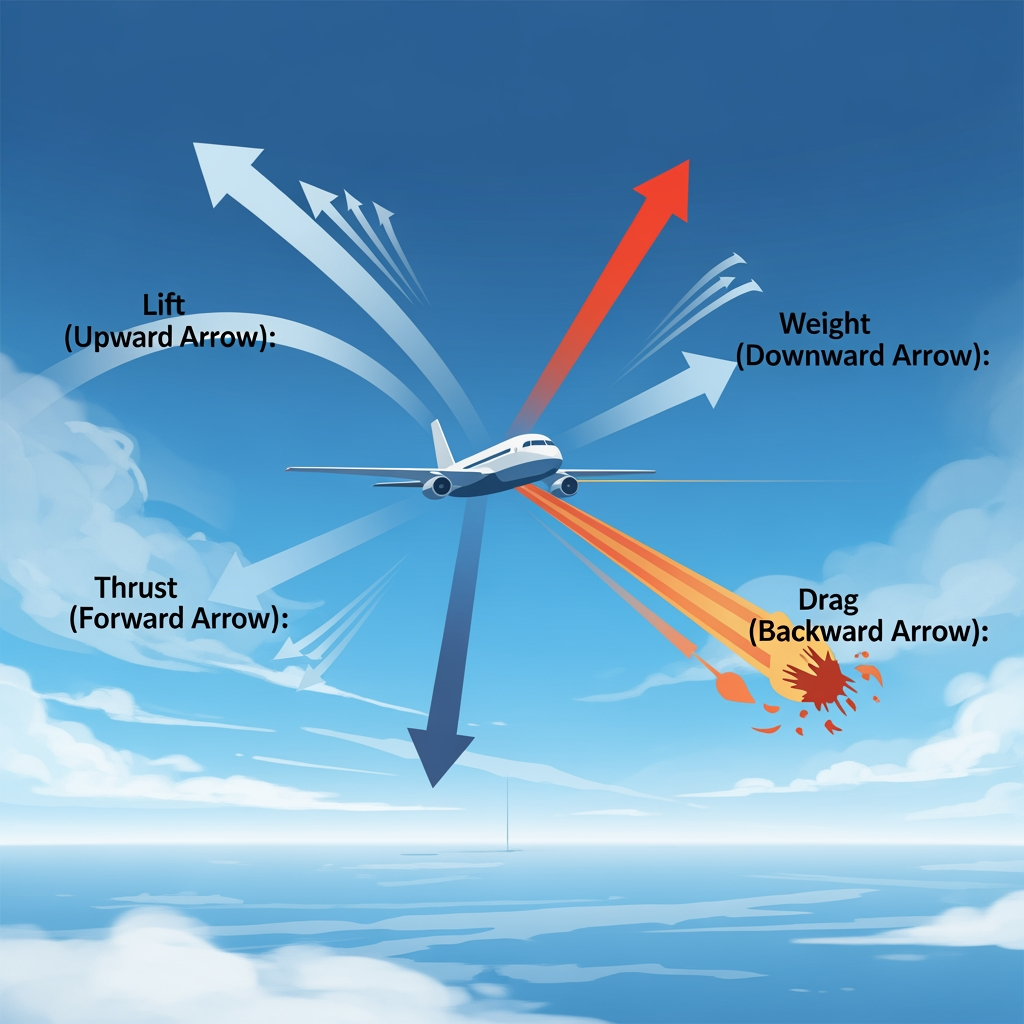
Flight involves balancing four forces: lift opposing weight, thrust opposing drag. When these forces balance, the plane flies level. Changing the balance allows climbing, descending, or accelerating.
This article was generated by AI to provide informational content.