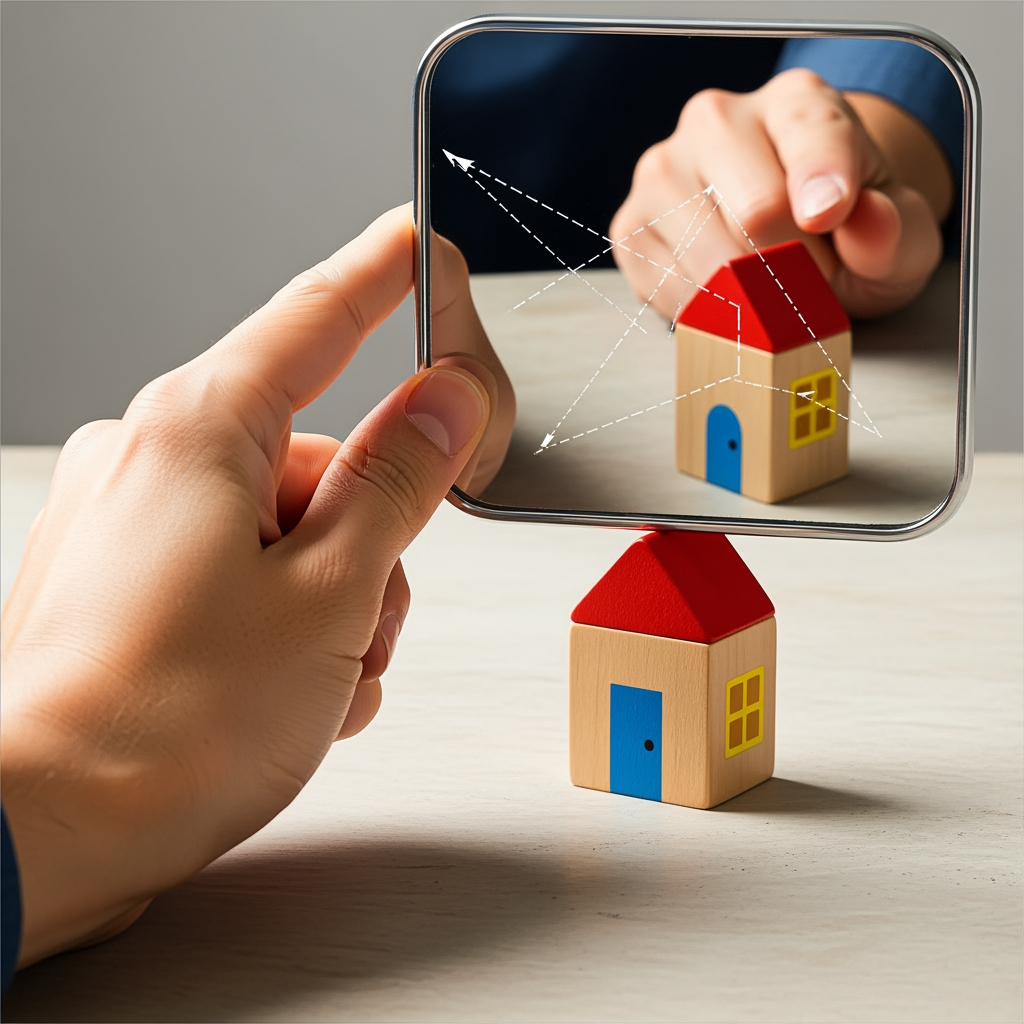
You look in a mirror and see yourself looking back. This everyday experience involves light physics that explains both why mirrors reflect and why the reflection appears reversed.
The Reflective Surface
Modern mirrors are glass sheets backed with thin metal coating, typically aluminum or silver. Light passes through the glass, hits the metal, and bounces back. The metal's electrons absorb and re-emit light at the same angles, creating a clear reflection.
The Law of Reflection
Light bounces off smooth surfaces at the same angle it arrives, like a ball bouncing off a wall. Each point in your reflection comes from light that traveled to the mirror and returned along symmetric paths to your eyes.
Why Smooth Matters
Rough surfaces also reflect light, but in scattered directions. This diffuse reflection is why you can't see your reflection in paper. The mirror's molecular smoothness ensures all light reflects uniformly.
The Reversal Question
Mirrors don't actually swap left and right. They reverse front-to-back. If you face north and look in a mirror, your reflection also faces north (toward you). What we perceive as left-right reversal is actually depth inversion.
Why Not Perfect?
No mirror reflects 100% of light—some is absorbed. The slight absorption is why reflections appear slightly dimmer than direct viewing. Multiple reflections compound this loss, explaining why infinity mirrors get darker with each repetition.
This article was generated by AI to provide informational content.