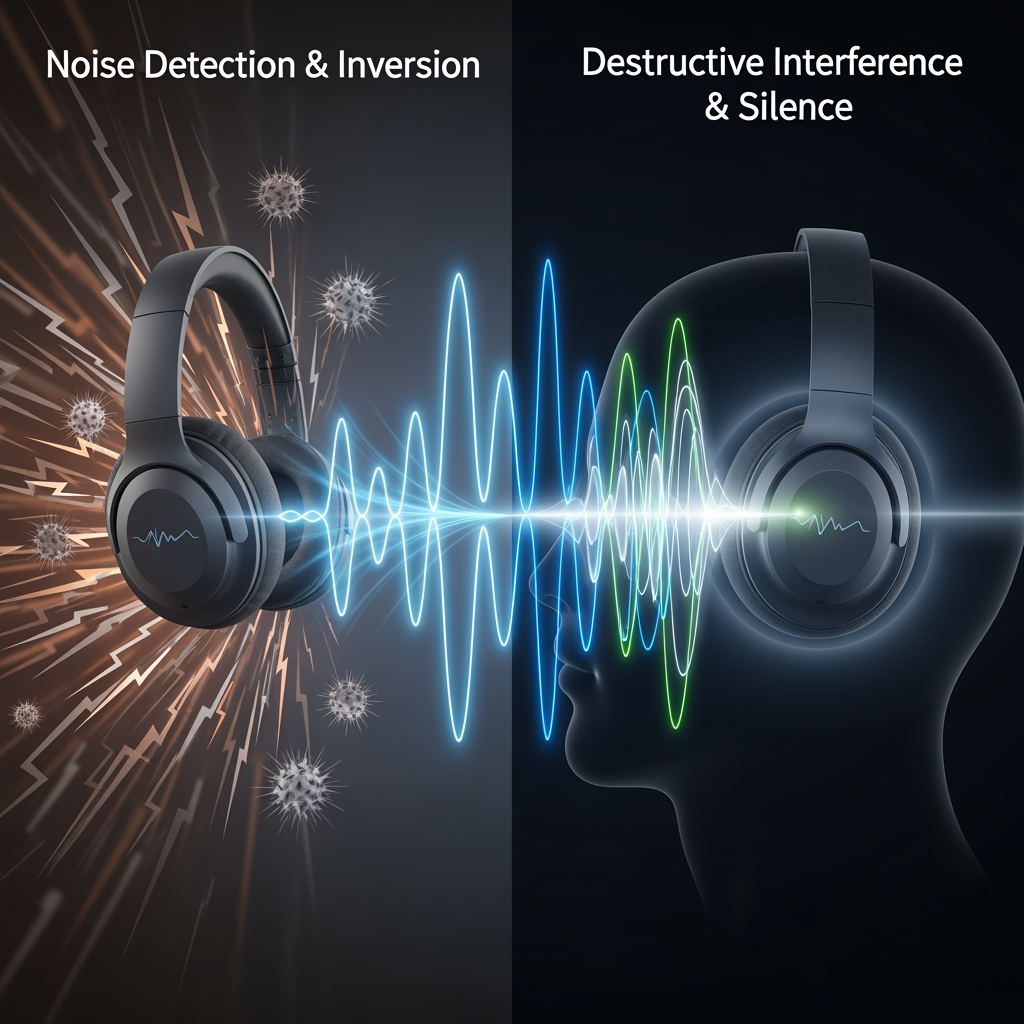
Put on noise-canceling headphones and the roar of an airplane cabin fades to a whisper. This seemingly magical technology uses physics against itself—fighting sound with more sound.
Sound as Waves
Sound travels as pressure waves through air. These waves have peaks (high pressure) and troughs (low pressure). When two waves meet, they can combine or cancel depending on their alignment.
Destructive Interference
When a peak meets a trough of equal magnitude, they cancel out—destructive interference. The result is silence. Noise-canceling headphones exploit this principle by generating sound that opposes incoming noise.
The Technology
Tiny microphones on the headphones detect ambient sound. Electronics analyze these sound waves and generate inverted versions—where the original has a peak, the generated sound has a trough. Speakers play this anti-noise.
Why It Works Better for Some Sounds
Steady, low-frequency sounds are easiest to cancel. The electronics have time to predict and generate matching anti-noise. Sudden, high-frequency sounds are harder—by the time electronics respond, the original sound has changed.
Passive vs. Active
Good noise-canceling headphones also use passive isolation—physical barriers that block sound. The combination of passive blocking (for high frequencies) and active cancellation (for low frequencies) provides comprehensive noise reduction.
Battery Required
Active noise cancellation requires power for microphones and electronics. When batteries die, you lose the cancellation but retain passive isolation and normal audio playback.
This article was generated by AI to provide informational content.