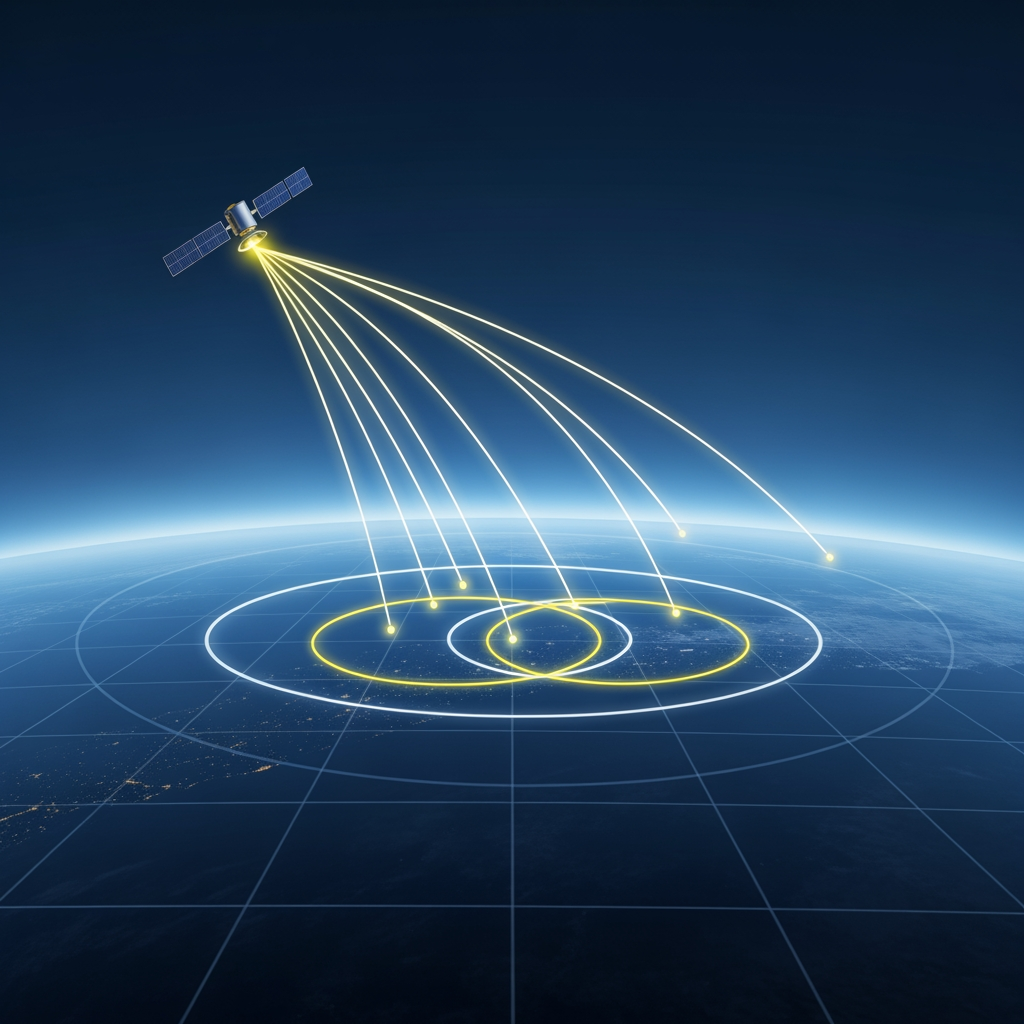
Your phone pinpoints your location to within meters using satellites orbiting 12,500 miles above Earth. This remarkable technology relies on precise timing and basic geometry.
The Satellite Constellation
At least 24 GPS satellites orbit Earth, arranged so that at least four are visible from any point on the planet at any time. Each satellite continuously broadcasts its position and exact time from onboard atomic clocks.
Trilateration
Your GPS receiver calculates distance to each visible satellite based on how long the signal took to arrive. Knowing the distance to three satellites places you somewhere on a sphere around each one. Where three spheres intersect determines your position.
The Fourth Satellite
A fourth satellite is needed to correct timing errors. Your device's clock isn't as precise as satellite atomic clocks. The fourth measurement allows the system to solve for time as well as position, eliminating clock errors.
Incredible Precision Required
Light travels about one foot per nanosecond. To locate you within meters, timing must be accurate to billionths of a second. The atomic clocks on GPS satellites are accurate to within a few billionths of a second per day.
Sources of Error
Atmospheric conditions, signal reflections off buildings, and satellite position errors all introduce inaccuracies. Modern GPS corrects for many of these. Differential GPS systems achieve centimeter accuracy by comparing signals with reference stations.
This article was generated by AI to provide informational content.