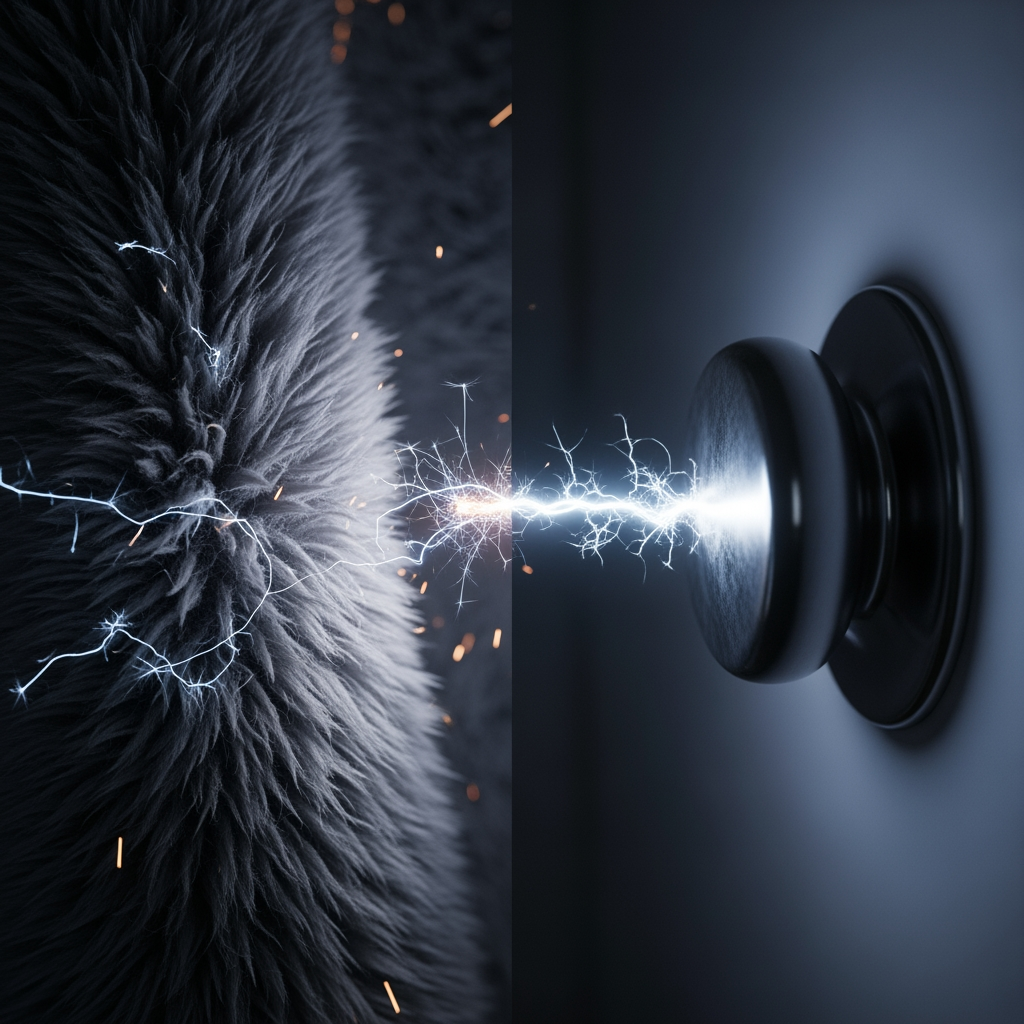
You shuffle across carpet, touch a doorknob, and zap—a spark jumps between you and the metal. That momentary shock involves the same fundamental forces that hold atoms together.
Electrons on the Move
Everything contains positive and negative charges, normally in balance. When certain materials rub together, electrons transfer from one to the other. The material gaining electrons becomes negatively charged; the one losing them becomes positive.
The Triboelectric Series
Some materials readily give up electrons; others eagerly accept them. Rubber and wool are on opposite ends of this spectrum—rub them together and significant charge transfer occurs. Synthetic fabrics and dry hair also create substantial static.
Why Winter Is Worse
Humidity affects static electricity dramatically. Water molecules in the air provide a path for charge to dissipate gradually. Dry winter air lacks this path, allowing charge to build up until it discharges suddenly as a spark.
The Spark Itself
Air normally insulates against electrical flow. But enough accumulated charge can ionize air molecules, creating a conductive path. Electrons jump the gap in a microsecond, heating the air and creating the visible spark and audible pop.
Lightning Is Static
Lightning works identically on a massive scale. Ice particles in clouds transfer charge through collision. Charge builds until it overcomes air's insulating properties, creating a massive spark between cloud and ground—or between clouds.
This article was generated by AI to provide informational content.