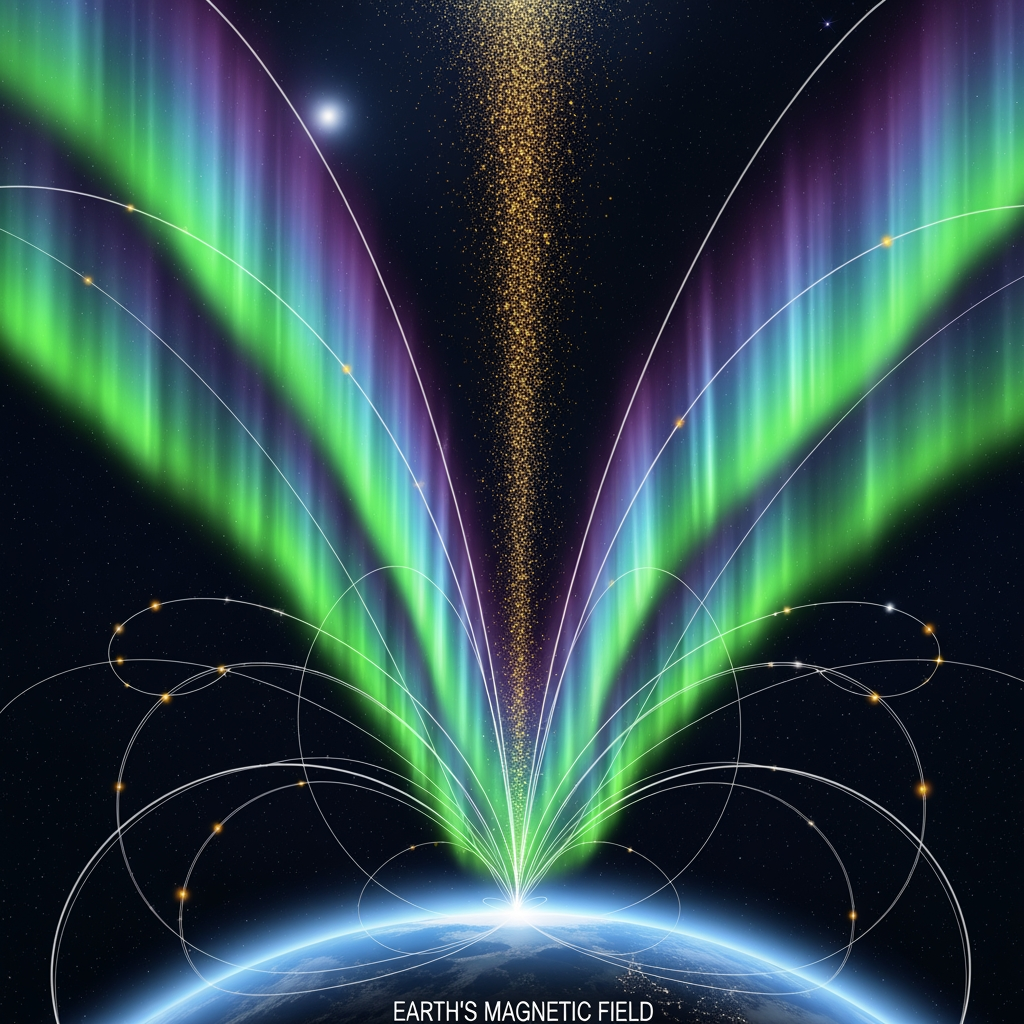
Shimmering curtains of green, red, and purple dance across polar skies. The aurora borealis has inspired wonder for millennia. Modern science reveals an explanation almost as magical as the mythology.
The Sun's Contribution
The sun constantly releases charged particles—electrons and protons—in a stream called the solar wind. During solar storms, this wind intensifies dramatically, sending billions of tons of charged particles toward Earth.
Earth's Magnetic Shield
Earth's magnetic field deflects most solar wind around the planet. However, some particles funnel down toward the magnetic poles where field lines converge. This is why auroras occur primarily at high latitudes.
Collisions Create Light
When solar particles collide with atmospheric gases, they transfer energy. Excited atoms release this energy as light. Different gases produce different colors—oxygen creates green and red, nitrogen produces blue and purple.
The Shapes and Movement
Aurora patterns reflect Earth's magnetic field lines. The shimmering movement results from varying solar wind intensity and complex interactions between charged particles and the magnetic field. No two auroral displays are identical.
Southern Hemisphere Too
The aurora australis mirrors the northern lights at the opposite pole. Both occur simultaneously, connected by Earth's magnetic field. Southern displays are less observed simply because fewer people live at extreme southern latitudes.
This article was generated by AI to provide informational content.