Gravity keeps your feet on the ground and planets in orbit. Newton described how it works mathematically. But Einstein revealed gravity isn't a force at all—it's the shape of space itself.
Newton's Description
Newton's law of gravitation describes gravity as an attractive force between masses, decreasing with distance squared. This works perfectly for most calculations—launching rockets, predicting orbits, engineering bridges.
Einstein's Revolution
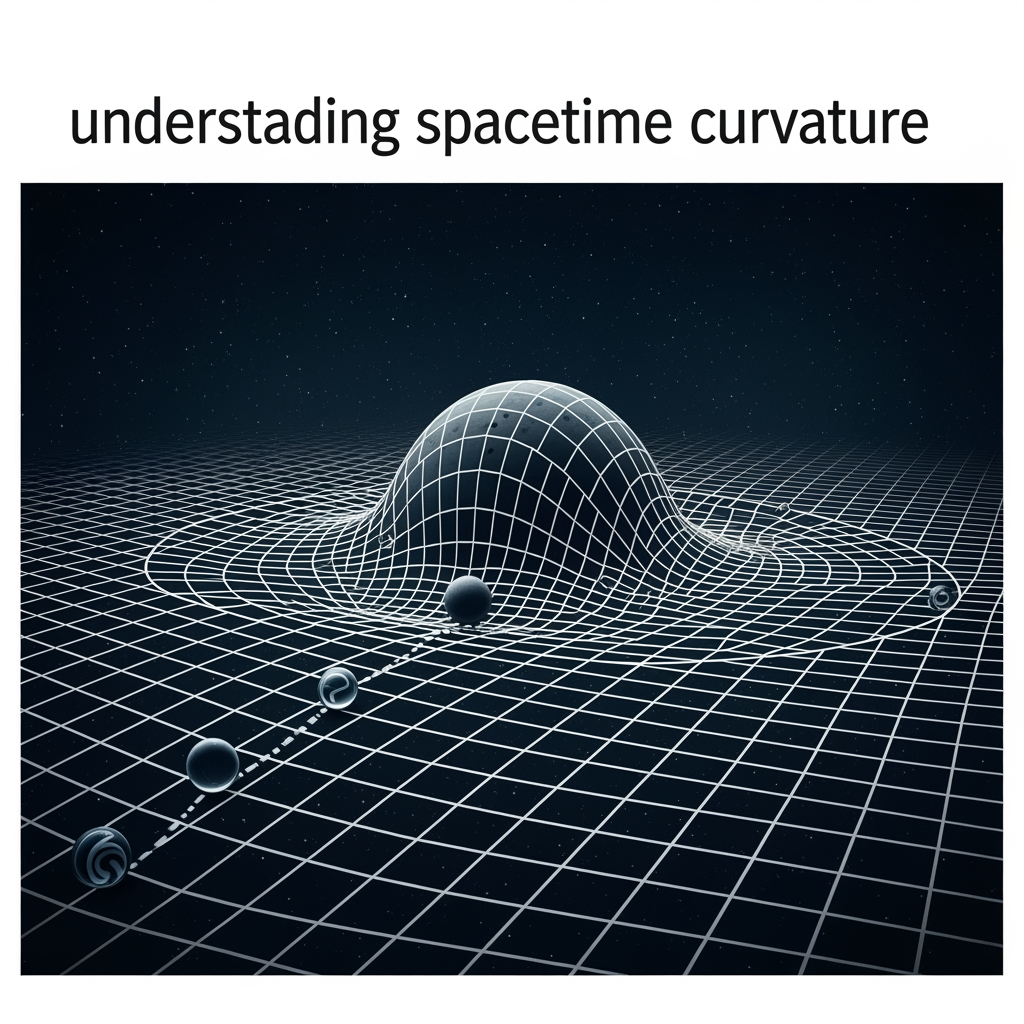
Einstein's general relativity reimagines gravity entirely. Mass warps the fabric of spacetime. Objects moving through this warped space follow curved paths we interpret as gravitational attraction. They're simply following the shape of reality.
The Bowling Ball Analogy
Imagine a stretched rubber sheet with a bowling ball creating a depression. Marbles rolled nearby curve toward the depression—not because the bowling ball pulls them, but because the surface itself is curved. Similarly, Earth curves spacetime, and falling objects follow that curvature.
Predictions and Evidence
Einstein's view predicts phenomena Newton's can't explain: gravitational time dilation (GPS satellites must account for this), gravitational lensing (light bending around massive objects), and gravitational waves (ripples in spacetime detected in 2015).
The Remaining Mystery
General relativity explains gravity beautifully at large scales but conflicts with quantum mechanics at tiny scales. A quantum theory of gravity remains elusive—one of physics' greatest unsolved problems.
This article was generated by AI to provide informational content.