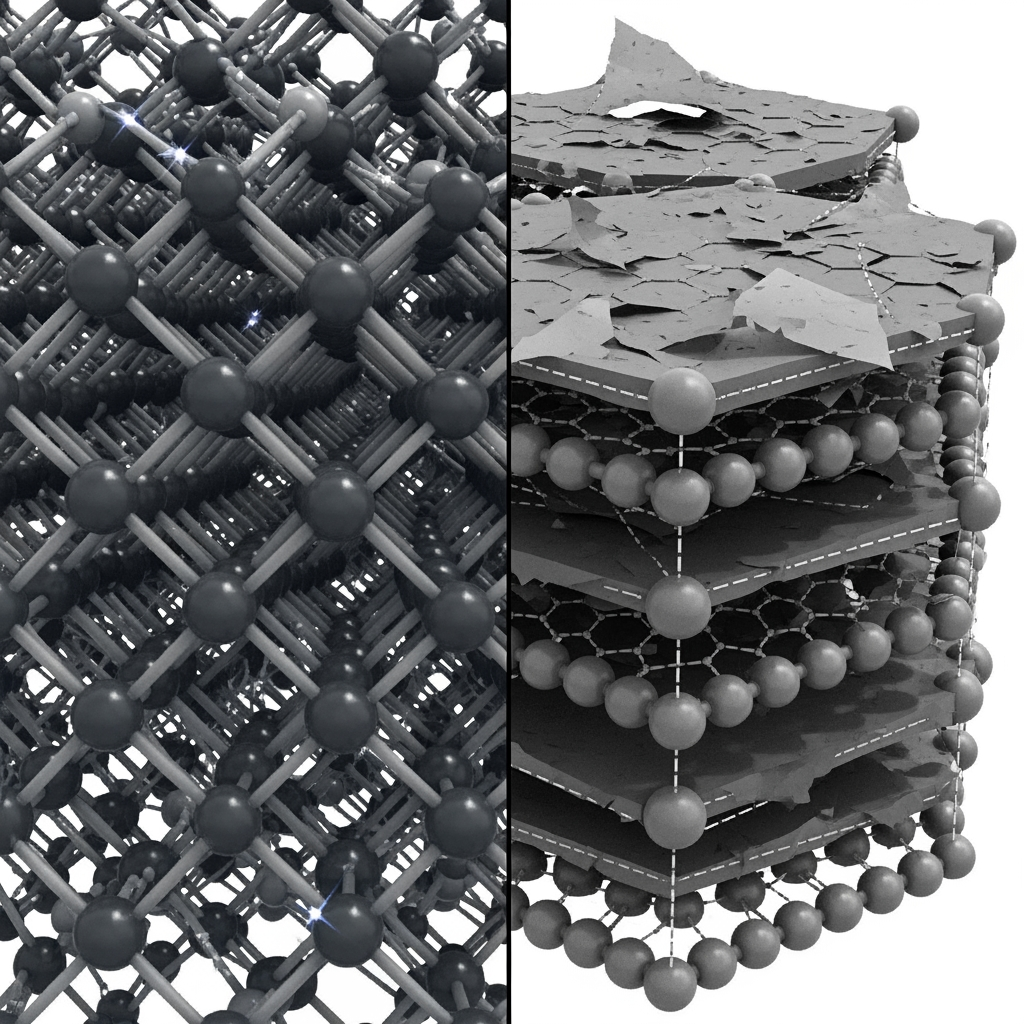
Diamonds can scratch anything else but nothing scratches them. This hardness made diamonds prized long before they became wedding symbols. The secret lies in how carbon atoms arrange themselves.
Pure Carbon
Diamonds are pure carbon—the same element as graphite in pencils and soot from fires. What makes diamonds different isn't the ingredient but how atoms connect to each other.
The Crystal Structure
In diamonds, each carbon atom bonds to four neighbors in a rigid three-dimensional lattice. These bonds are among the strongest in chemistry—short, tight, and uniform in all directions. The structure has no weak points.
Comparing to Graphite
Graphite is also carbon, but its atoms form flat sheets weakly connected to each other. Sheets slide apart easily, which is why graphite makes good pencil lead. Same atoms, different arrangement, vastly different properties.
Formed Under Pressure
Natural diamonds form 100+ miles underground where extreme pressure and temperature force carbon into the dense diamond structure. Volcanic eruptions then bring them to the surface in rare geological events.
Synthetic Diamonds
Humans now create diamonds by replicating these conditions or through chemical vapor deposition. Synthetic diamonds are chemically identical to natural ones and equally hard. They're increasingly used in industrial cutting tools.
Not Indestructible
Hardness measures scratch resistance, not overall toughness. Diamonds can chip or shatter if struck at the right angle along crystal planes. They can also burn at high temperatures—they're carbon, after all.
This article was generated by AI to provide informational content.