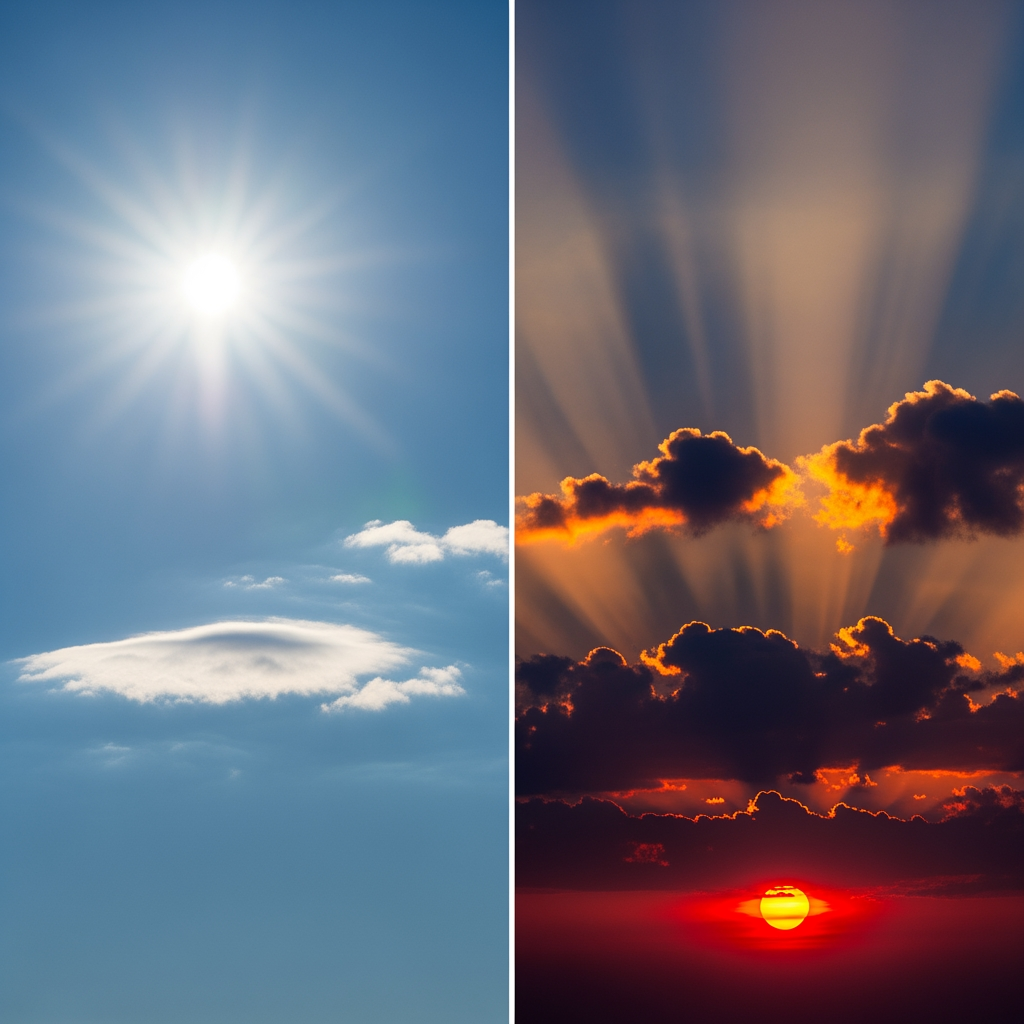
Both events involve the sun at the horizon, yet sunsets typically display more vibrant colors. The difference has less to do with physics and more to do with what's in the air.
The Same Basic Process
Both sunrises and sunsets color the sky through Rayleigh scattering. When sunlight travels through more atmosphere at low angles, blue light scatters away, leaving longer wavelengths—reds and oranges—to dominate.
Afternoon Accumulation
Throughout the day, air collects dust, pollution, and other particles. By evening, the atmosphere holds more of these scatterers than it did in the morning. More particles create more scattering and more vivid colors.
Temperature Differences
Mornings tend to be cooler with more stable air. Evening air, heated by the day's sun, creates turbulence that mixes particles throughout the atmosphere. This mixing keeps particles suspended where they can scatter sunset light.
Moisture Patterns
Evaporation throughout the day adds moisture to the air. Water droplets contribute to light scattering. Relative humidity typically peaks in evening, enhancing sunset colors.
Regional Variations
In some places, sunrises rival or exceed sunsets. Coastal areas with morning sea breezes can have stunning sunrises. Desert regions with minimal pollution might see equally beautiful displays at both times.
Photography Factor
Fewer people are awake to observe and photograph sunrises. This observational bias might contribute to the perception that sunsets are more spectacular.
This article was generated by AI to provide informational content.